
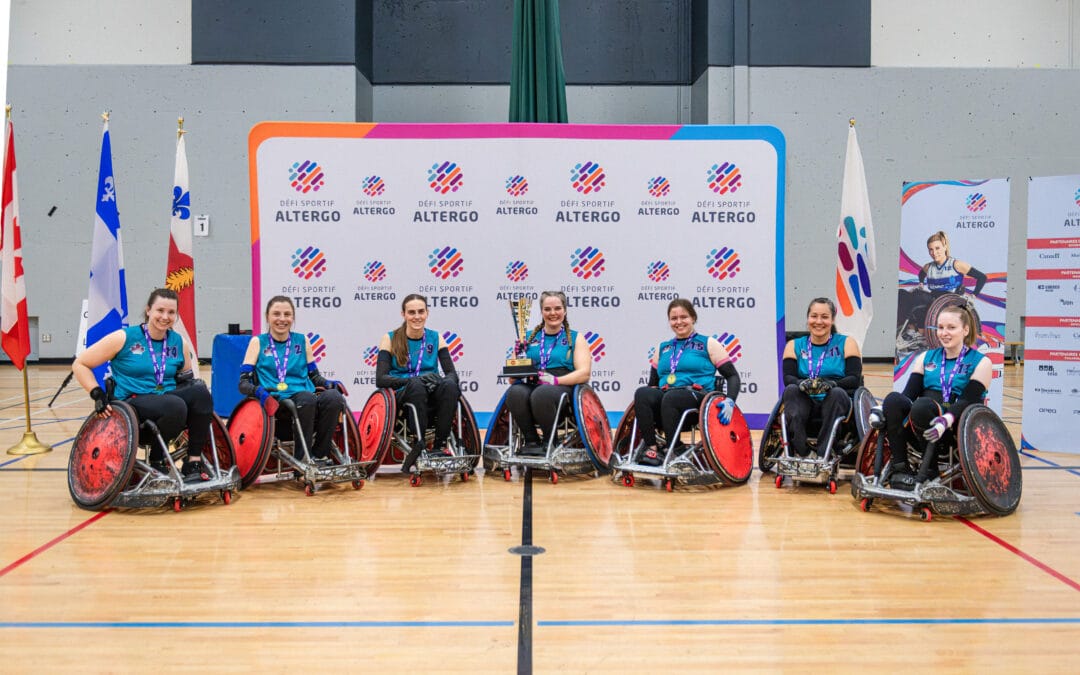
On Sunday, a truly historic moment unfolded at the Défi sportif AlterGo, when the Western Lights became the first-ever gold medallists at the inaugural Women’s Wheelchair Rugby National Championship.
For the entire weekend, the three teams competing in the first-of-its-kind tournament battled it out in a series of close, highly competitive matches.
Off the court, however, there was a genuine spirit of camaraderie and goodwill between the players. Despite the competitive nature of the tournament, the athletes were extremely proud to be part of a major milestone in the development of their sport.
An emotional look back
“When we first started in 2023, there were only about 8 girls who played regularly. But now, in 2026, there are 23 women in my chat group, and there are 21 here this weekend. It’s really great,” said wheelchair rugby player Mélanie Labelle, one of the athlete ambassadors for the 43rd Défi sportif AlterGo.
With emotion in her voice, Labelle explained that the first all-women’s training camp took place one year ago. Following that, the league decided to create a calendar of events, although it hadn’t yet considered the possibility of a championship tournament at the national level.
The idea of developing women’s wheelchair rugby came to Labelle when she noticed the dearth of opportunities for female players.
“I knew I was the only woman on the national team, but I noticed that at the training camp, there were several women in attendance. And I wondered, what kinds of opportunities were available to them to improve as athletes? Not many.”
This lack of opportunities persists despite the measures that have been put in place to encourage the participation of female athletes, explained Erika Schmutz, the first woman to win a Paralympic medal in wheelchair rugby as part of the Canadian team in 2008.
“Even though there are advantages to having a woman on the court, the female athletes still aren’t getting the playing time. They’re not being put in when the games count. The only way we’re going to develop women’s rugby is by having a separate women’s division.”
Schmutz still likes to compete, but that isn’t the main reason she returned to the world of women’s wheelchair rugby.
“Honestly, seeing 3 amazing women’s teams playing against each other, I’m blown away. That’s why I came back. That’s why I’m here. Because it means so much. And I can see how much it means to them. And I’m here to encourage them to keep pushing forward. That’s their goal, and I want to be here with them, helping them.”
A valued collaboration
According to Labelle, the players are eager to compete, but a lack of funding remains a barrier to hosting major competitions.
Funding is one of the next major issues the team—composed mostly of volunteers—must tackle as its members work tirelessly to keep the Canadian women’s wheelchair rugby program afloat.
For this reason, the decision by the Défi sportif AlterGo to help organize the first-ever Women’s Wheelchair Rugby National Championship was greatly appreciated by the athletes.
“Since I’m from Quebec, holding it in Montreal feels significant, and the partnership we’ve established with the Défi sportif AlterGo isn’t something we want to see come to an end—it’s something we want to keep building, year after year,” explained Labelle.
Schmutz also expressed a deep sense of gratitude toward the Défi.
“The fact that they stepped up when we needed them the most, that they hosted us… That will always mean a lot.”
Toward the Paralympic Games?
The Women’s National Championship is a first step toward the ultimate goal: the inclusion of women’s wheelchair rugby in the Paralympic Games.
And, with the first International Women’s Championship set to take place in Paris in December 2026, the possibility that the sport could be included in the 2032 Paralympic Games in Brisbane has begun to appear within reach.
“It is too soon? I don’t know, but that’s the goal. Are we working toward it? Yes. Do we want it to happen? Yes. Is the sport growing in other countries? Yes. So we’ll see,” stated Labelle.
In the meantime, now that the first-ever Women’s Wheelchair Rugby National Championship has come to a close, the athletes will return home to their respective local mixed teams. “The opportunity is there now. It’s a chance for them to develop, at their own pace, together,” concluded Labelle.